
Children rarely say their vision is blurry. They assume everyone sees the way they do, and simply struggle at school, sit close to the TV or tilt their head to look. Many childhood eye problems respond better to treatment when they are found early, which is why a proper eye check matters even when a child seems fine.
At a glance
- Who it is for
- Children referred after school screening, children with a squint, suspected lazy eye or difficulty seeing, and families with a history of glasses or squint
- Testing
- Picture and matching charts, eye alignment and movement checks, and focusing drops when needed for an accurate glasses power
- Treatment
- Glasses, patching or drops for lazy eye, and regular reviews. Surgery is arranged by referral when needed.
- Hours
- Monday to Saturday, 10 AM to 2 PM and 5 PM to 9 PM. Closed on Sunday.
- Languages
- English, Hindi, Marathi, Gujarati
A white glow in the pupil, seen in person or in a photograph, needs a prompt eye examination. It is not always a camera effect. An eye injury, sudden pain or sudden loss of vision needs urgent care the same day.
Why a full eye check matters
School and camp screenings are useful, but a screening is not a full eye examination. It flags children who need one. Vision develops through early childhood, and problems such as lazy eye respond better to treatment when they are caught young, ideally before about seven or eight years of age, although older children can still benefit.
Signs to watch for
- closing or covering one eye, or tilting the head to look
- an eye that turns in, out, up or down, all the time or only when tired
- holding books very close or sitting close to the TV
- squinting at the board, or headaches after school
- rubbing the eyes often or blinking a lot
- a referral after school screening
- a family history of squint, lazy eye or high spectacle numbers
Some children with poor vision in one eye show no signs at all, which is why a check before starting school is worthwhile.
Conditions that are checked
Short sight, long sight and astigmatism
These are the most common reasons children need glasses. Short sight is becoming more common in children, and more time outdoors is linked with a lower risk of developing it.
Lazy eye (amblyopia)
Vision does not develop fully in one eye, or less often both, because of a squint, a big difference in glasses power between the eyes, or something blocking the view. The eye itself can look normal.
Squint (strabismus)
The eyes point in different directions, often called bhengapan in Hindi. A squint can lead to lazy eye and should be checked, not left to see whether the child grows out of it.
Watering eyes in babies
A blocked tear duct often causes watering and sticky eyes in babies, and many clear up during the first year. An examination rules out other causes.
What happens at the check-up
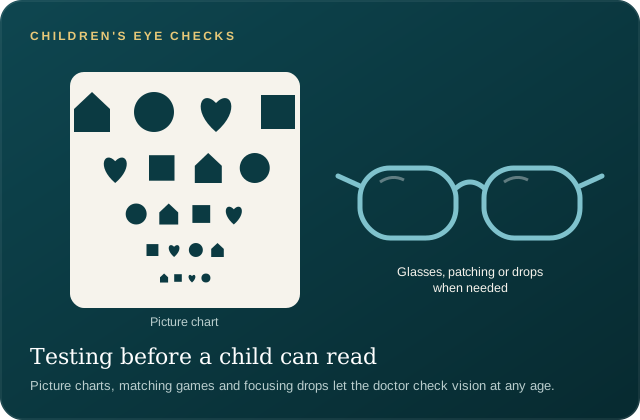
Tests are adapted to your child's age. Children do not need to read letters to have their vision checked: picture charts, matching games and watching how a child follows objects all work. Eye alignment and movement are checked too.
Focusing drops are often used to relax the eye's focusing and measure an accurate glasses power. They blur near vision and make bright light uncomfortable for several hours, sometimes until the next day, so allow time for them to work before the examination continues.
Treatment and follow-up
Treatment depends on what is found. It may include glasses worn all day, patching the stronger eye for a set number of hours, or drops that blur the stronger eye so the weaker one has to work. The schedule is set by the doctor, and regular reviews check progress.
Please do not start patching on your own or use another child's glasses. If surgery or care beyond the clinic is needed, for example a squint operation, specialist referral is arranged.
Preparing your child
- explain the visit simply: "The doctor will check how your eyes see"
- bring a favourite toy or a snack
- bring previous glasses, prescriptions and any screening letter
- mention family eye history, premature birth and any health conditions
- allow extra time, because focusing drops take a while to work
- avoid promising that there will be no drops
Cost
Please call or WhatsApp the clinic for consultation charges, and ask whether repeat visits or glasses are charged separately. If ongoing treatment is advised, the review schedule is explained so you can plan.
About your doctor
Dr. Shirish Patel is a consultant eye surgeon at Advanced Eyecare Centre, Goregaon West.
- MBBS, Seth G.S. Medical College and KEM Hospital, Mumbai
- DNB Ophthalmology, PBMA's H.V. Desai Eye Hospital, Pune
- FICO (A+B)
- Registered with the Maharashtra Medical Council, Reg. No.: to be added
- Consultations in English, Hindi, Marathi and Gujarati
Education and training in full →
Visiting the clinic
Advanced Eyecare Centre
1st Floor, A Wing, Ariha Signature, 105, near Jain Sweets, Jawahar Nagar, Goregaon West, Mumbai 400104
Hours: Monday to Saturday, 10 AM to 2 PM and 5 PM to 9 PM. Closed on Sunday.
Phone: +91 98338 52420 · WhatsApp: +91 74003 22526
The clinic is in Jawahar Nagar, Goregaon West, within easy reach of Malad, Jogeshwari, Andheri and Kandivali. Open in Google Maps →
A WhatsApp or phone message is not an emergency service. For sudden severe eye pain or vision loss, go to the nearest emergency department.
Questions parents ask
When should my child have their first eye check?
Before starting school, and earlier if you notice an eye turn, a white glow in the pupil, or there is a family history of squint or lazy eye.
Can a child be checked before they can read?
Yes. Picture charts, matching games and watching how the child follows objects let the doctor check vision at any age.
Will my child grow out of a squint?
Do not assume so. A squint that stays, or comes and goes, needs an examination because it can lead to lazy eye.
Do glasses make children's eyes weaker?
No. Glasses do not weaken the eyes. They let a child see clearly, and for lazy eye they are often part of the treatment.
Does screen time cause short sight?
Long hours of close work and little time outdoors are linked with short sight in children. Regular breaks and some outdoor play every day help.
Does every child with an eye problem need patching?
No. Patching is for lazy eye in selected children, with a schedule set and reviewed by the doctor.
What does a children's eye check cost?
Please call or WhatsApp the clinic for current consultation charges.
Is the clinic open on Sunday?
No. The clinic is open Monday to Saturday, 10 AM to 2 PM and 5 PM to 9 PM.
Sources: National Eye Institute · AAPOS · NHS
This page explains children's eye care in general. It is not a diagnosis and does not replace an examination or an individual treatment plan. For sudden vision loss, severe eye pain or injury, go to your nearest emergency department immediately.