
The cornea is the clear window at the front of the eye, and it does most of the eye's focusing. When its shape or clarity changes, vision changes too, often in ways that new glasses cannot fix. Keratoconus is one of the main causes in teenagers and young adults, and it is easier to manage when it is found early.
At a glance
- Who it is for
- A frequently changing number, rising or irregular astigmatism, suspected or known keratoconus, corneal infections and scars
- At the clinic
- Corneal topography, slit-lamp examination and specialty contact lens fitting (RGP, scleral, hybrid)
- Cross-linking (CXL)
- Arranged by referral when the cornea is changing
- Hours
- Monday to Saturday, 10 AM to 2 PM and 5 PM to 9 PM. Closed on Sunday.
- Languages
- English, Hindi, Marathi, Gujarati
The cornea and what can go wrong
The cornea needs to stay clear and evenly curved to focus light. Infections, injuries, scars and inherited conditions called dystrophies can cloud it. Keratoconus changes its shape.
What keratoconus is
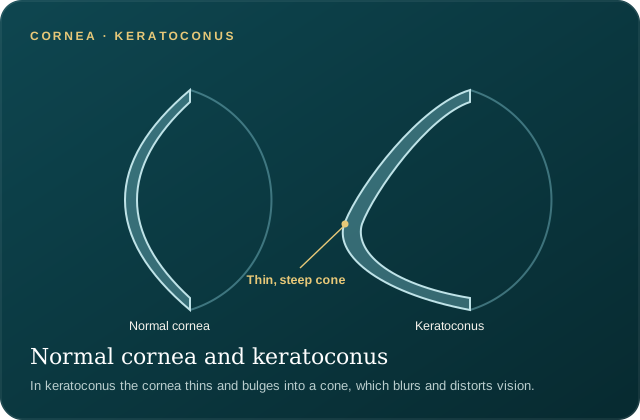
In keratoconus, the cornea gradually thins and bulges forward into a cone. Vision becomes blurred and distorted, astigmatism rises, and the spectacle number keeps changing. It usually starts in the teens or twenties and tends to slow down by the thirties or forties.
It is more common in people who rub their eyes a lot, in people with eye allergies, and in families where someone already has it. Keratoconus also rules out laser vision correction, which is why corneal mapping is part of every LASIK screening.
When to get assessed
- your spectacle number changes often
- vision stays unclear even with new glasses
- lights cause glare, streaks or ghosting
- you have been told your cornea is irregular or your astigmatism is high
- you already have keratoconus and need monitoring
- someone in the family has keratoconus
None of these confirms keratoconus on its own. The corneal map does.
How the cornea is assessed
The assessment includes your vision and spectacle number, a slit-lamp examination, and corneal topography, a detailed map of the corneal shape done at the clinic. Repeat maps over months show whether the cornea is stable or still changing, so bring any earlier scans. Contact lenses, especially rigid ones, change the corneal shape, so ask how long to leave them out before your visit.
Treatment has two separate goals
Seeing clearly
In early keratoconus, glasses may be enough. When they are not, specially fitted contact lenses usually give much sharper vision, because they create a smooth new front surface. Options include rigid gas-permeable (RGP), scleral and hybrid lenses, and the fitting is done at the clinic.
Slowing the disease
Corneal collagen cross-linking (CXL, sometimes called C3R) uses riboflavin drops and ultraviolet light to stiffen the cornea and reduce further bulging. Its purpose is to stop the cornea changing, not to remove your spectacle number. Suitability depends on whether the cornea is progressing and how thick it is. When cross-linking is advised, it is arranged by referral.
Advanced cases
When contact lenses can no longer give useful vision, a corneal transplant may be considered. Most people with keratoconus never need one. If it is advised, you will be told who will perform it and where.
Infections, scars and other corneal problems
Corneal infections need prompt treatment with the right medicine, because they can leave scars that affect vision. Scars and dystrophies are treated according to their cause and how much they affect sight, with medicines, specialty lenses or surgery by referral.
A painful red eye in a contact lens wearer is an emergency. Remove the lenses, do not put them back in, and see an eye doctor the same day. Severe pain, sudden blurred vision or an injury to the eye also needs urgent care.
After cross-linking
For a few days after cross-linking, expect discomfort, watering, light sensitivity and blurred vision while the surface heals, usually under a bandage contact lens. Drops and follow-up visits matter, and infection and corneal haze are the main risks. Vision can take several weeks to settle, and contact lenses are refitted afterwards.
Cost
Charges depend on the tests, contact lens fitting and any procedure advised. Please call or WhatsApp the clinic to enquire. For contact lenses, ask about the cost of replacement lenses as well as the first fitting.
About your doctor
Dr. Shirish Patel is a consultant eye surgeon at Advanced Eyecare Centre, Goregaon West.
- MBBS, Seth G.S. Medical College and KEM Hospital, Mumbai
- DNB Ophthalmology, PBMA's H.V. Desai Eye Hospital, Pune
- FICO (A+B)
- Registered with the Maharashtra Medical Council, Reg. No.: to be added
- Consultations in English, Hindi, Marathi and Gujarati
Education and training in full →
Visiting the clinic
Advanced Eyecare Centre
1st Floor, A Wing, Ariha Signature, 105, near Jain Sweets, Jawahar Nagar, Goregaon West, Mumbai 400104
Hours: Monday to Saturday, 10 AM to 2 PM and 5 PM to 9 PM. Closed on Sunday.
Phone: +91 98338 52420 · WhatsApp: +91 74003 22526
The clinic is in Jawahar Nagar, Goregaon West, within easy reach of Malad, Jogeshwari, Andheri and Kandivali. Open in Google Maps →
A WhatsApp or phone message is not an emergency service. For sudden severe eye pain or vision loss, go to the nearest emergency department.
Questions patients ask about keratoconus
Will cross-linking remove my glasses number?
No. Cross-linking aims to stop the cornea changing. Glasses or contact lenses are usually still needed afterwards.
Does everyone with keratoconus need a corneal transplant?
No. Most people manage with glasses, specialty contact lenses, monitoring and cross-linking where needed. A transplant is for advanced cases.
Can I have LASIK if I have keratoconus?
Laser surgery removes corneal tissue and can make keratoconus worse, so it is not done. Other options, such as specialty lenses or an implantable lens in a stable eye, can be discussed.
Should I stop rubbing my eyes?
Yes. Eye rubbing is linked with keratoconus getting worse. If itching makes you rub, the allergy behind it should be treated.
Should I bring my previous corneal scans?
Yes. Comparing scans over time is the clearest way to tell whether the cornea is stable or changing.
What does keratoconus treatment cost?
It depends on the tests, lenses or procedure your eyes need. Please call or WhatsApp the clinic to enquire.
Is the clinic open on Sunday?
No. The clinic is open Monday to Saturday, 10 AM to 2 PM and 5 PM to 9 PM.
Sources: American Academy of Ophthalmology · National Eye Institute · Moorfields Eye Hospital
This page explains cornea and keratoconus care in general. It is not a diagnosis and does not replace an examination or an individual treatment plan. For sudden vision loss, severe eye pain or injury, go to your nearest emergency department immediately.