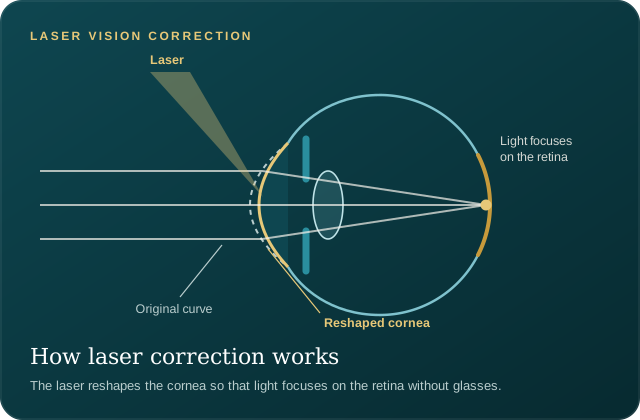
Laser vision correction changes the shape of the cornea so that light focuses on the retina without glasses. It works well for many people, but not for every eye. The most important part is the screening that decides whether surgery is safe for you, and which procedure suits your cornea.
At a glance
- Who it is for
- Adults with a stable spectacle or contact lens number who want less dependence on glasses
- Options discussed
- Customised LASIK, Femto LASIK, SMILE, PRK and ICL
- Screening
- Corneal mapping, corneal thickness, tear film and a full eye examination before any recommendation
- Contact lenses
- Leave soft lenses out for at least a week, and rigid lenses for three to four weeks, before the screening
- Hours
- Monday to Saturday, 10 AM to 2 PM and 5 PM to 9 PM. Closed on Sunday.
- Languages
- English, Hindi, Marathi, Gujarati
What refractive surgery does
Refractive surgery corrects short sight (myopia), long sight (hyperopia) and astigmatism. Laser procedures reshape the cornea, the clear front window of the eye. An implantable contact lens (ICL) works differently: a thin lens is placed inside the eye, in front of your natural lens, without removing any corneal tissue.
The aim is to reduce your dependence on glasses or contact lenses. It is not a promise of perfect vision for life, and choosing to stay with glasses is always a reasonable decision.
Who may be suitable
Your spectacle number is only one part of the picture. Surgery is usually considered when:
- you are at least 18, and preferably over 21
- your number has been stable for at least a year
- the cornea is healthy, regular in shape and thick enough for the correction needed
- your tear film is healthy, or dry eye has been treated first
- there is no active eye disease, and you are not pregnant or breastfeeding
- your expectations match what the procedure can do
Laser surgery corrects distance vision, but it does not stop the need for reading glasses that arrives for everyone in their mid-forties. If you are over 40, this is discussed before anything else.
Being told you are not suitable is a valid result of the screening. An ICL, a different laser procedure, or simply glasses and contact lenses may be the better choice.
The screening
The screening usually includes:
- your spectacle number, measured with and without focusing drops
- corneal topography, a detailed map of the corneal shape that picks up early keratoconus
- corneal thickness (pachymetry)
- a tear film and dry eye check
- pupil size in dim light
- a dilated examination of the retina, because higher short sight can come with thin areas at the edge of the retina
Corneal topography is done at the clinic. Bring your old prescriptions, since they show how stable your number has been. Contact lenses change the shape of the cornea, so leave soft lenses out for at least a week (two weeks for toric or extended-wear lenses) and rigid lenses for three to four weeks before the screening.
Procedures that may be discussed
| Procedure | How it works | Usually suits |
|---|---|---|
| LASIK and Femto LASIK | A thin flap is made on the cornea, by blade or by femtosecond laser, and the laser reshapes the tissue underneath | Short sight, long sight and astigmatism, with a healthy cornea of good thickness |
| SMILE | A thin disc of tissue is removed through a small opening, without a flap | Short sight and astigmatism, and people who play contact sports |
| PRK | The surface layer is removed and the laser reshapes the surface, without a flap. Early recovery is slower. | Thinner corneas, or jobs with a risk of eye injury |
| ICL | A thin lens is placed inside the eye, in front of the natural lens | High spectacle numbers, or corneas not suited to laser |
Most people see well enough for daily tasks within a day of LASIK, within one to three days of SMILE, and after about a week with PRK. How the procedures compare, and who is advised against laser, is explained in the LASIK vs SMILE vs PRK guide. Where the procedure will be done is discussed at your consultation.
Benefits, limits and risks
Every procedure has limits and risks, and they are explained before you decide:
- Dry eye, common in the first months and usually settling by three to six months
- Glare and haloes around lights at night, which usually fade over time
- A small leftover number, or a slow return of the number, sometimes treatable with an enhancement
- Flap problems, with LASIK only, which are rare
- Infection, which is rare
- Corneal weakening (ectasia), rare, and the main reason corneal mapping is never skipped
An ICL has its own risks, including raised eye pressure, cataract and infection, and sometimes needs further surgery.
Preparation and recovery
On the day, avoid eye make-up and arrange for someone to take you home. The procedure itself takes about ten to fifteen minutes per eye, under numbing drops.
Afterwards you use drops for a few weeks, wear protective shields while sleeping for the first few nights as advised, and avoid rubbing your eyes, swimming and dusty places. Follow-up visits are usually the next day, at one week, one month and three months. Driving resumes once your vision has been checked.
After surgery, severe pain, worsening vision, increasing redness or discharge needs same-day advice. Call the clinic, and if you cannot reach it quickly, go to the nearest emergency eye service. Do not wait for a routine visit or a WhatsApp reply.
Cost and insurance
The cost depends on which procedure your eyes are suitable for, so an estimate is given after the screening. Please call or WhatsApp the clinic to enquire.
When you receive an estimate, check whether it covers both eyes, the screening tests, medicines, follow-up visits and any later enhancement. Most health policies exclude refractive surgery, but some cover higher spectacle numbers, so ask your insurer in writing.
About your doctor
Dr. Shirish Patel is a consultant eye surgeon at Advanced Eyecare Centre, Goregaon West.
- MBBS, Seth G.S. Medical College and KEM Hospital, Mumbai
- DNB Ophthalmology, PBMA's H.V. Desai Eye Hospital, Pune
- FICO (A+B)
- Registered with the Maharashtra Medical Council, Reg. No.: to be added
- Consultations in English, Hindi, Marathi and Gujarati
Education and training in full →
Visiting the clinic
Advanced Eyecare Centre
1st Floor, A Wing, Ariha Signature, 105, near Jain Sweets, Jawahar Nagar, Goregaon West, Mumbai 400104
Hours: Monday to Saturday, 10 AM to 2 PM and 5 PM to 9 PM. Closed on Sunday.
Phone: +91 98338 52420 · WhatsApp: +91 74003 22526
The clinic is in Jawahar Nagar, Goregaon West, within easy reach of Malad, Jogeshwari, Andheri and Kandivali. Open in Google Maps →
A WhatsApp or phone message is not an emergency service. For sudden severe eye pain or vision loss, go to the nearest emergency department.
Questions patients ask about LASIK
Am I too young or too old for LASIK?
You need to be at least 18, and your number should have been stable for a year, which often means waiting until after 21. There is no fixed upper age, but after about 40 reading glasses are still needed for close work, and other options may suit you better.
Is the newest laser procedure always the right choice?
No. The right procedure depends on your corneal thickness and shape, your number, your tear film and your work or sport, not on how new the technology is.
Will I never need glasses again?
No one can promise that. Most people need reading glasses from their mid-forties whatever surgery they had, and some keep a light pair for night driving.
What happens if my eyes are not suitable?
You are told why. An ICL, a different laser procedure, or continuing with glasses or contact lenses may be the safer choice.
How long should I stop wearing contact lenses before the screening?
Soft lenses for at least a week, or two weeks for toric and extended-wear lenses. Rigid gas-permeable lenses for three to four weeks, sometimes longer.
Are both eyes treated on the same day?
For LASIK, SMILE and PRK, both eyes are usually treated in the same session. An ICL is often placed one eye at a time.
What does LASIK cost?
It depends on the procedure your eyes are suitable for. Please call or WhatsApp the clinic for an estimate after your screening.
Is the clinic open on Sunday?
No. The clinic is open Monday to Saturday, 10 AM to 2 PM and 5 PM to 9 PM.
Sources: American Academy of Ophthalmology · National Eye Institute
This page explains refractive surgery in general. It is not a diagnosis and does not replace an examination or an individual treatment plan. For sudden vision loss, severe eye pain or injury, go to your nearest emergency department immediately.